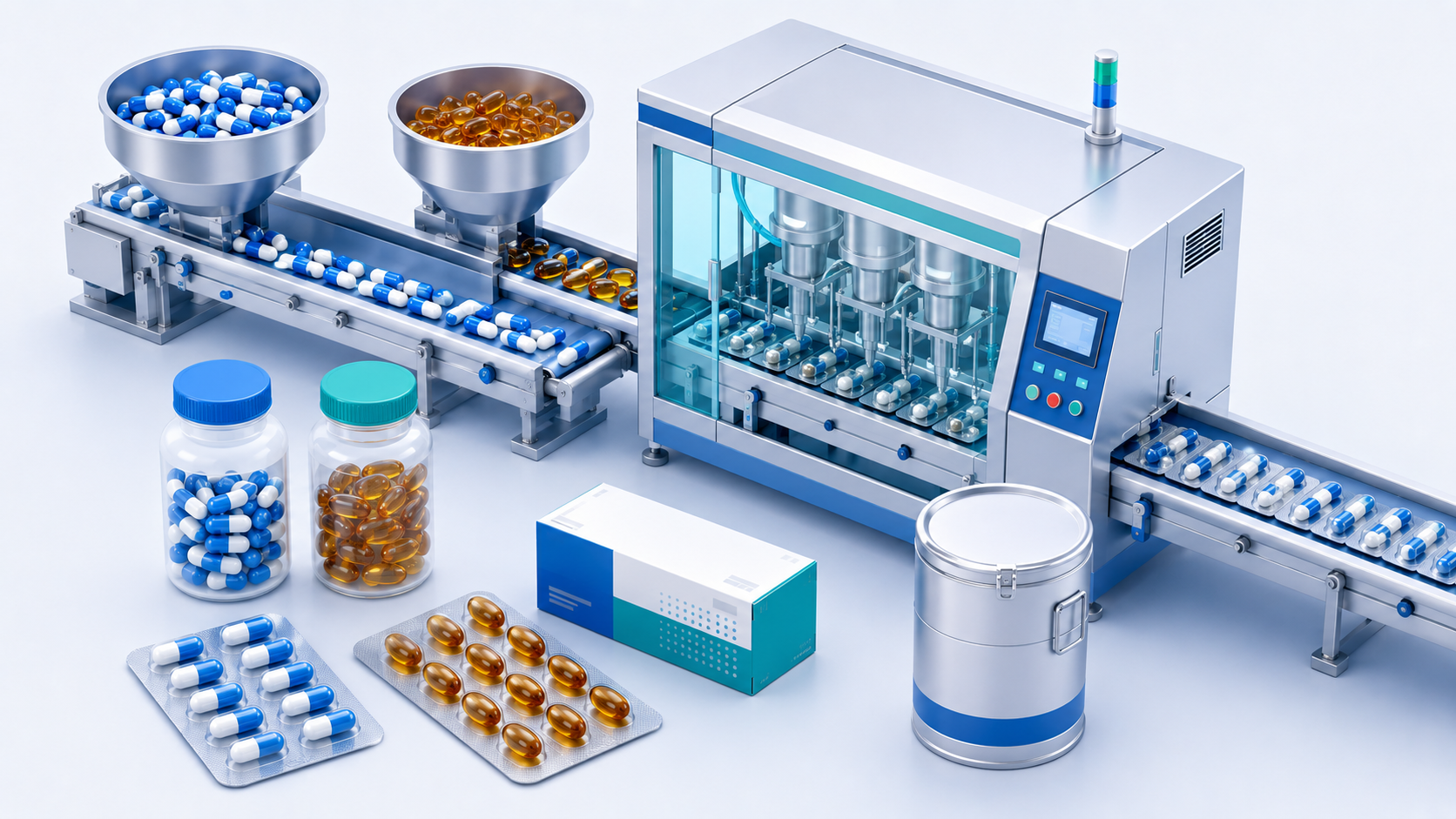
Capsule third party manufacturing lets you launch your own branded range of hard-gelatin capsules and softgels without owning a plant or a fill line. You supply the brand, composition and packaging brief; a certified manufacturer formulates, fills, encapsulates, tests and packs the product to your specification. For distributors, nutraceutical brands, marketing companies and entrepreneurs across India, it is the fastest, lowest-risk way to add capsules and oil-filled softgels to your portfolio. This guide explains the difference between the two formats, what suits each, the process, MOQ, packaging, documents and what drives price.
Key takeaways (TL;DR)
- Hard-gelatin capsules suit powders, granules and pellets; softgels suit oils, liquids and semi-solids.
- Third-party (contract) manufacturing means your brand, the manufacturer’s certified facility and fill line.
- Softgels are the preferred format for omega-3, vitamin E, fish oil and other oil-based nutraceuticals.
- To begin you typically need a Drug License and GST (FSSAI for nutraceutical capsules).
- Price depends on the formulation, shell type, MOQ, packaging and quality specs — always confirm a quote.
Hard-gelatin capsules vs softgels: what’s the difference?
Both are oral capsule formats, but they are made and filled very differently. A hard-gelatin capsule is a two-piece shell (cap and body) filled with a dry blend — powder, granules or pellets. A softgel (soft-gelatin capsule) is a single sealed shell, usually filled with an oil, liquid or semi-solid and formed in one continuous encapsulation step. Choosing the right format is mainly about the physical nature of your active ingredient.
| Capsule type | Best suited fills | Common uses |
|---|---|---|
| Hard-gelatin capsule | Powders, granules, pellets, dry blends | Antibiotics, multivitamins, probiotics, herbal/Ayurvedic powders, general Rx range |
| Softgel (soft-gelatin) | Oils, liquids, oily suspensions, semi-solids | Omega-3/fish oil, vitamin E, vitamin D3, evening primrose oil, CoQ10, multivitamin oils |
| Vegetarian (HPMC) capsule | Powders/pellets, plant-based brands | Vegan nutraceuticals, halal/kosher ranges, clean-label supplements |
What suits capsules vs softgels (oils & nutraceuticals)
If your composition is a dry powder or a blend of dry actives — most antibiotics, probiotic blends, herbal extracts and multivitamin powders — a hard-gelatin or vegetarian capsule is usually the right and most economical choice. If your active is an oil or dissolves in oil, a softgel is the natural format: it seals the liquid, masks taste and odour, and gives a premium look that sells well in the nutraceutical and wellness segments.
- Go with hard-gelatin/veg capsules for dry actives, powders, pellets and most prescription ranges.
- Go with softgels for omega-3, fish oil, vitamin E, D3, evening primrose oil, garlic oil and other oil-based nutraceuticals.
- Veg (HPMC) shells are ideal for vegetarian, vegan, halal or kosher positioning.
- Enteric or delayed-release coatings can be applied where a product needs to bypass the stomach.
How the capsule & softgel manufacturing process works
| Step | What happens |
|---|---|
| 1. Enquiry & selection | Share your capsule/softgel products, composition, format and quantities. |
| 2. Quotation | Manufacturer shares net rates, MOQ, shell options and timelines. |
| 3. Documentation | Submit Drug License, GST, FSSAI (if applicable) and brand/trademark details. |
| 4. Formulation & samples | Blend or fill mass is developed; samples/standards are approved. |
| 5. Filling & encapsulation | Hard capsules are filled; softgels are encapsulated and dried. |
| 6. QC & packing | Products are quality-tested, then blistered/bottled, labelled and dispatched. |
Packaging options for capsules and softgels
- Blister / Alu-Alu strips: the standard for capsules and softgels; Alu-Alu protects moisture- and light-sensitive fills.
- HDPE bottles: popular for nutraceutical softgels and bulk multivitamin packs (often 30/60/90 count).
- Mono-cartons & inserts: add brand presentation, dosage panel and leaflet space.
- Induction sealing & desiccants: used for hygroscopic or oxidation-prone oils to extend shelf life.
Documents required to start
- Drug License Number (wholesale or manufacturing, as applicable)
- GST registration
- FSSAI licence (for nutraceutical/food-supplement capsules and softgels)
- Brand name & trademark (TM) details for your products
- Product list with composition, shell preference and packaging specs
MOQ and what drives pricing
| Factor | Effect on cost / order |
|---|---|
| Composition / active | Oils, omega-3 and specialty actives cost more than basic powders |
| Format & shell | Softgels and veg (HPMC) shells usually cost more than standard hard-gelatin |
| Order quantity (MOQ) | Larger batches lower the per-capsule cost |
| Packaging | Alu-Alu, HDPE bottles, mono-cartons and inserts add cost |
| Quality & export specs | Higher specs (stability data, export-grade) increase cost |
MOQs and rates vary by format, composition and manufacturer — softgel MOQs are often higher than hard-capsule MOQs. Always confirm exact terms for your requirement.
Why choose Kroyf Labs for capsule & softgel manufacturing
Kroyf Labs brings 16+ years of experience, a 400+ DCGI & FSSAI-approved product range and over 1350 associates, with WHO-GMP, ISO and FDA-standard manufacturing across tablets, capsules, softgels, syrups, injectables, eye drops and nutraceuticals. From hard-gelatin and vegetarian capsules to oil-filled softgels, we support formulation, packaging design and reliable pan-India supply from our Mumbai and Panchkula operations — so you can launch a quality capsule range under your own brand with confidence.
Ready to launch your capsule or softgel range? Request a manufacturing quote from Kroyf Labs →
Frequently asked questions
What is the difference between a hard-gelatin capsule and a softgel?
A hard-gelatin capsule is a two-piece shell filled with a dry blend such as powder, granules or pellets. A softgel is a single sealed shell formed in one step and filled with an oil, liquid or semi-solid. The right choice depends on whether your active is dry or oil-based.
Which format is best for omega-3 and oil-based nutraceuticals?
Softgels are best for omega-3, fish oil, vitamin E, D3 and other oil-based actives. The sealed shell holds the liquid securely, masks taste and odour, and gives a premium finish that performs well in the nutraceutical and wellness segments.
What documents are needed for capsule third party manufacturing?
A Drug License and GST registration are the essentials, plus your brand or trademark details. An FSSAI licence is required for nutraceutical and food-supplement capsules and softgels.
What is the minimum order quantity (MOQ) for capsules and softgels?
MOQ depends on the format, composition and shell type. Softgel MOQs are often higher than hard-capsule MOQs, and larger batches reduce the per-unit cost. Confirm the exact MOQ for each product with the manufacturer.
Can vegetarian capsules be manufactured instead of gelatin?
Yes. Vegetarian capsules use an HPMC (plant-based) shell instead of gelatin, which suits vegan, halal, kosher and clean-label positioning. Most dry-fill products can be made in either a gelatin or HPMC shell.
Author: Kroyf Labs Editorial Team — insights based on Kroyf Labs’ 16+ years in pharmaceutical manufacturing and PCD franchise across India. This article is general business information and not medical or legal advice. Figures are indicative; confirm exact terms with the manufacturer.