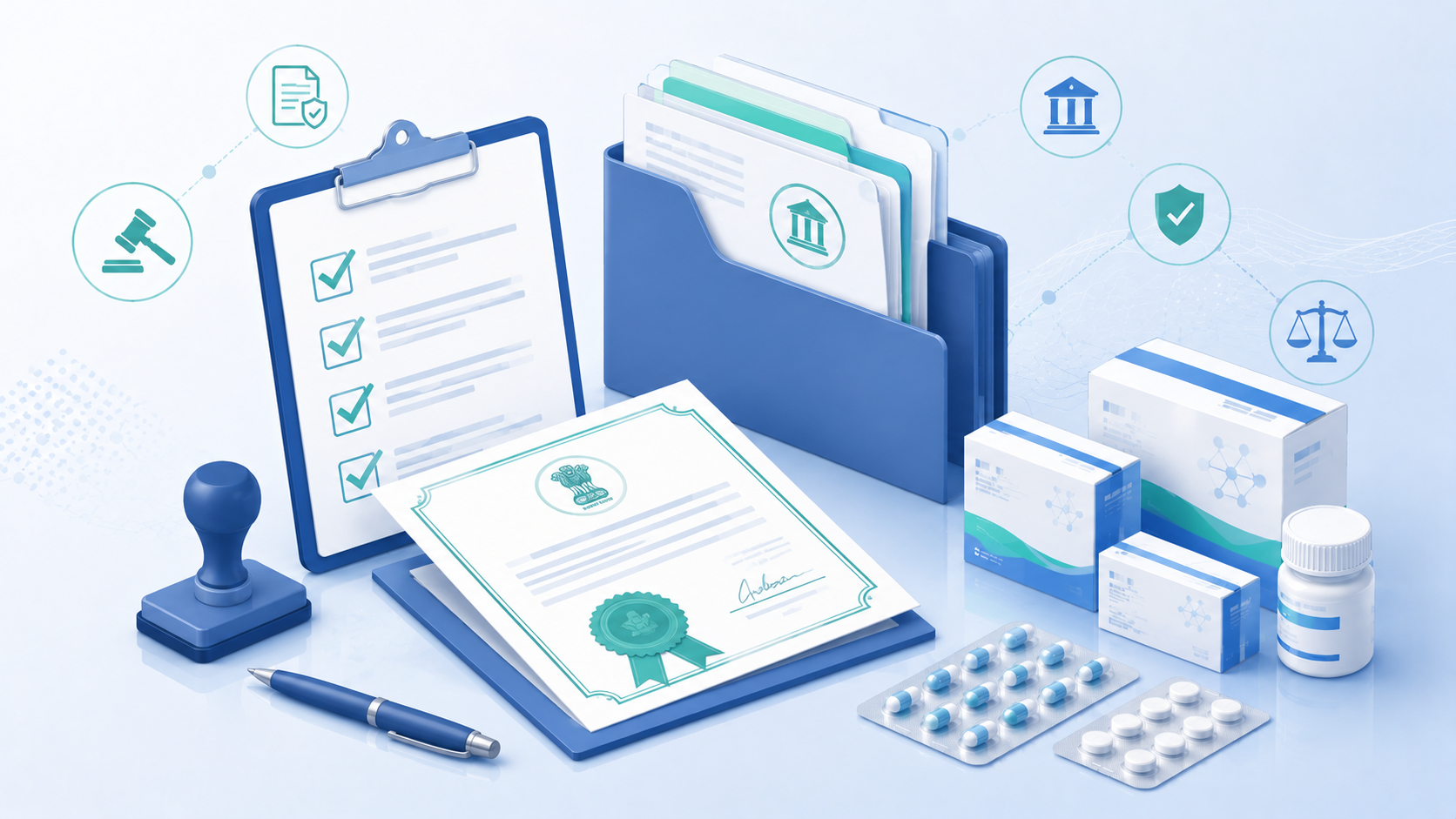
Starting a PCD pharma franchise is one of the fastest, lowest-investment ways to enter India’s pharmaceutical market — but your application stalls the moment paperwork is missing. The documents required for a PCD pharma franchise are not complicated, yet most first-time partners lose weeks because they have not arranged a Drug License, GST registration or the right agreements in advance. This guide lists every document you need, explains how to obtain a drug license, clarifies wholesale vs retail licensing, and flags the common mistakes that delay approvals — with a ready-to-use checklist table.
Key takeaways (TL;DR)
- The two non-negotiables are a valid Drug License Number and a GST registration.
- You also need PAN, an identity proof (Aadhaar/voter ID), and bank account details for billing and dispatch.
- A signed franchise & monopoly agreement protects your territory and pricing rights.
- A drug license requires either a registered pharmacist (retail) or a competent person/graduate with experience (wholesale).
- For distribution, a wholesale drug license is what most PCD franchise partners need — not a retail one.
What is a PCD pharma franchise — and why documents matter
PCD stands for Propaganda Cum Distribution. In a PCD pharma franchise, a manufacturer grants you the right to market and distribute its branded products in an assigned territory, usually on a monopoly basis. You handle local promotion and supply; the company handles manufacturing, quality and packaging.
Because you are buying, stocking and selling scheduled medicines, the law treats you as a drug business — not a general trader. That is why a verified set of documents is mandatory before any reputable company will appoint you. Correct paperwork protects both sides: it confirms you can legally hold and sell drugs, and it secures your territory and margins in writing.
Documents required for a PCD pharma franchise
Here is what every applicant should keep ready. Each document plays a specific role — legal eligibility, tax identity, KYC, or commercial protection.
- Drug License Number: a valid wholesale (or retail) drug license issued by the State Drug Control Department. This is the single most important document — without it, you cannot legally purchase or sell medicines.
- GST registration certificate: the GSTIN under which you will be billed and will raise invoices. Mandatory for inter-state stock movement and input tax credit.
- PAN card: the Permanent Account Number of the proprietor, firm or company, used for all financial and tax records.
- Identity & address proof: Aadhaar card, voter ID or passport of the applicant, plus proof of your business premises (electricity bill, rent agreement or property papers).
- Franchise & monopoly agreement: a signed contract defining your territory, product list, pricing, monopoly rights, payment terms and duration.
- Bank account details: a cancelled cheque or bank certificate in the firm’s name for payments, refunds and dispatch verification.
- Passport-size photographs and firm registration: recent photos of the proprietor and, where applicable, your shop & establishment or firm/partnership registration.
PCD pharma franchise documents checklist
| Document | Why it is needed | Issued / arranged by |
|---|---|---|
| Drug License Number (wholesale/retail) | Legal right to purchase, stock and sell medicines | State Drug Control Department |
| GST registration (GSTIN) | Tax invoicing, inter-state supply, input credit | GST portal / tax consultant |
| PAN card | Tax and financial identity of the firm/individual | Income Tax Department |
| Aadhaar / voter ID / passport | KYC and applicant identity proof | Government ID authority |
| Premises proof (rent deed / electricity bill) | Confirms a valid business address | Owner / utility provider |
| Franchise & monopoly agreement | Defines territory, pricing and monopoly rights | Manufacturer & franchise partner |
| Bank details (cancelled cheque) | Payments, billing and dispatch verification | Your bank |
| Passport-size photos / firm registration | Records and business legitimacy | Applicant / registrar |
Exact requirements can vary slightly by state and company — always confirm the current checklist before you apply.
How to obtain a drug license
The drug license is the document most new partners worry about, so it helps to break the process into clear steps. Licenses are issued by your State Drug Control Department under the Drugs and Cosmetics Act.
Step 1: Decide wholesale or retail
Choose the license type that matches how you will operate (see the comparison below). Most PCD distributors apply for a wholesale license.
Step 2: Arrange the competent person
A retail drug license requires a registered pharmacist. A wholesale drug license requires a competent person — typically a registered pharmacist, or a graduate with one year of experience in dealing with drugs (criteria vary by state).
Step 3: Ready the premises and storage
You need a minimum area (commonly around 10 square metres) and proper storage, including a refrigerator for products needing cold storage.
Step 4: Apply online and inspection
Submit Form 19 (or your state’s equivalent) with the required documents and fee on the state drug control portal. A drug inspector verifies your premises and records before the license is granted.
Wholesale vs retail drug license
| Basis | Wholesale drug license | Retail drug license |
|---|---|---|
| Purpose | Bulk distribution and supply to retailers/institutions | Direct sale to end consumers |
| Best for | Most PCD franchise distributors and stockists | Chemist shops and pharmacies |
| Competent person | Registered pharmacist or graduate with 1 year drug experience | Registered pharmacist (mandatory) |
| Typical form | Wholesale license under Form 20B / 21B | Retail license under Form 20 / 21 |
If your plan is to distribute branded products across a territory rather than run a shopfront, the wholesale drug license is usually the right choice.
Common mistakes that delay approval
- Applying without a drug license: companies cannot appoint you or dispatch stock until your license number is valid.
- Mismatched names: the name on your PAN, GST, drug license and bank account should match the same firm to avoid rejections.
- No written monopoly agreement: relying on a verbal promise leaves your territory and pricing unprotected.
- Wrong license type: taking a retail license when you actually need a wholesale one for distribution.
- Expired or incomplete documents: outdated GST details or missing premises proof stall verification.
Start your PCD franchise with the right partner
Kroyf Labs brings 16+ years of experience, 1350+ associates and a 400+ DCGI & FSSAI-approved product range across cardiology, dermatology, gastroenterology, diabetology, ophthalmic, pediatrics, antibiotics and nutraceuticals. With WHO-GMP, ISO and FDA-standard manufacturing and reliable pan-India supply from our Mumbai HQ and Panchkula operations, we make it simple to launch a PCD franchise — with a clear documents checklist, monopoly rights and transparent terms. Indicative single-territory investment starts around ₹25,000–₹1,00,000 with margins of roughly 20%–40%+; confirm exact terms for your range.
Ready to begin and want a full document checklist for your state? Enquire about a PCD franchise with Kroyf Labs →
Frequently asked questions
What documents are required for a PCD pharma franchise?
The core documents are a valid Drug License Number, GST registration, PAN card, an identity proof such as Aadhaar, premises proof, a signed franchise & monopoly agreement, and bank account details. Some companies also ask for photographs and firm registration.
Is a drug license mandatory to start a PCD pharma franchise?
Yes. A valid drug license is mandatory because you will purchase, stock and sell scheduled medicines. No reputable manufacturer can appoint you or dispatch stock until your drug license number is active.
How do I obtain a drug license?
Apply to your State Drug Control Department with the prescribed form, documents and fee. You need a qualified competent person — a registered pharmacist for retail, or a registered pharmacist or experienced graduate for wholesale — plus a compliant premises that passes inspection.
Do I need a wholesale or retail drug license?
For distributing branded products across a territory, a wholesale drug license is usually required. A retail license is meant for selling directly to consumers from a chemist shop or pharmacy.
What is a franchise and monopoly agreement?
It is a written contract between you and the manufacturer that defines your assigned territory, product list, pricing, monopoly rights, payment terms and duration. It protects your exclusive rights so no other partner sells the same products in your area.
Author: Kroyf Labs Editorial Team — insights based on Kroyf Labs’ 16+ years in pharmaceutical manufacturing and PCD franchise across India. This article is general business information and not medical or legal advice. Figures are indicative; confirm exact terms and current requirements with the company and your state authority.